
How the era of flash games shaped my sense of style (and sense of self), and how they all became lost media.
Although it seems nearly impossible to imagine now, there was a time when the internet lived in a room. My family’s PC was kept in a cherry armoire that seemed quaint and rustic compared to the futuristic wonders it contained. For a few hours after school and on select weekends, I would be allowed to sit at the altar of the World Wide Web, and after I outgrew spider solitaire and space pinball, there was only one game I wanted to play: dress up.
I grew up in a lower-middle-class that was rapidly vanishing. My family had enough money to get new clothes when I needed them, but popular mall brands like Justice, Abercrombie, and American Eagle were always out of my reach, and I was relegated to looking at my classmates in envy. Most of the clothes I wore were either off-brand, thrifted, or handed down by an older cousin. Dress-up games were a welcome escape from foam flip-flops and nylon gauchos into a world of fantastic glamour. The fact that I sit here writing these very words in a diamante Moschino bustier and Calvin Klein kitten heels is not only a realization of my childhood daydreams but also the result of having a certain lifestyle marketed towards me for nearly twenty years.
The ability to change an avatar’s appearance with a button also scratched an itch I knew existed but had difficulty articulating. Click. New hair. Click. New body. Click. New face. Even before I understood I was transgender, I started to think of myself as the avatar. Frustratingly, I was much less malleable than my digital counterparts.
Still, funny as it may seem, I credit some of my ability to put an outfit together to playing dress-up games. Experimentation is one of the most crucial aspects to becoming a good stylist, and I was able to experiment for years without leaving the computer room buying a single new item of clothing.
Coming from an area where Forever 21 was considered cutting-edge, these sites also exposed me to new fashion subcultures I would never have interacted with otherwise. I learned about visual and fairy kei, rococo, lolita, and cyberpunk, and it made me realize there was so much more to what fashion could be. I distinctly remember begging my dad to take me to Jo-Ann’s to buy neon green lycra so I could sew a top I had seen on GirlGames.com. That was dress-up games’ biggest impact: broadening my style imagination beyond real-world restrictions.

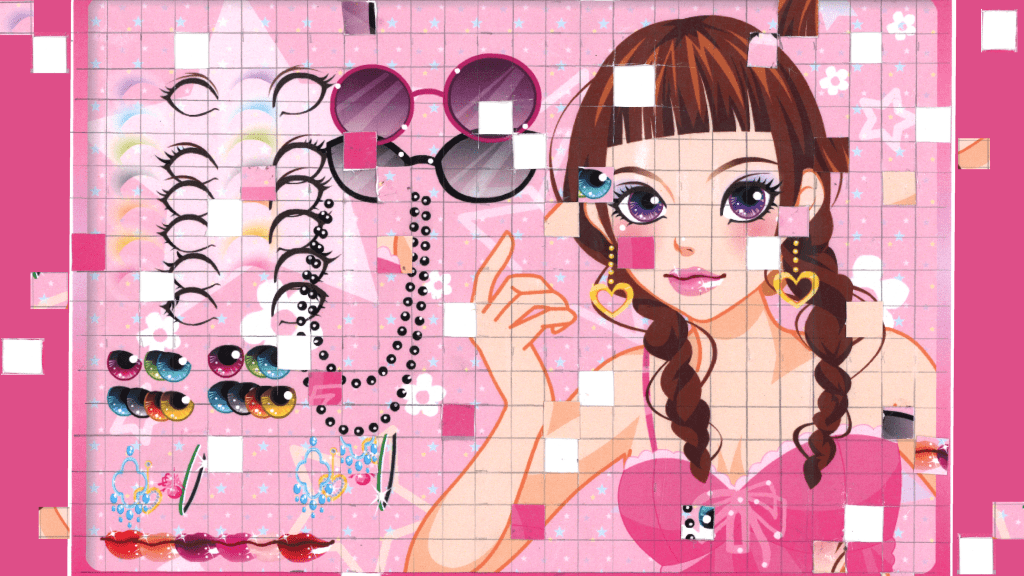
In the 2000s to early 2010s, there was GaiaOnline, MyScene, Fantage, Dressupgames, Pixie Hollow, Girlsgogames, rinmarugames, and Dollzmania… site upon site stacked on top of each other with big, chunky pink buttons and pixelated avatars. In the heyday of flash games, some of these sites would publish new games nearly every day. Most games had their own music, custom graphics, and 30-200 unique customization options. It was a wealth of creativity that I was too young to fully appreciate, and certainly, something I never considered to be ephemeral.
Although most of these websites shuttered in the 2010s due to server costs, pivoting interest from web browsers to mobile games, and issues with Adobe Flash Player, the death knell for online dress-up games came on January 12th, 2021. Adobe Flash finally shut down, and millions of sites were affected. A few creators and archivists were able to save or revive games through Flash emulators, but most were lost forever, leaving only pixelated memories behind. There is often an assumption (after years of being told by our parents, teachers, and employers) that once something is online, it’s there forever. This is not true. High-profile disappearances like the Batgirl movie, Westworld, and Coyote vs. Acme have drawn attention to the ephemerality of digital media, but the prevailing attitude is still short-sighted. With any form of archiving, there is a belief that someone else will surely do it, but when faced with the massive amount of information on the Internet, it is simply not possible for anyone to save all of it. Unless we take care to back up, physically save, or otherwise memorialize our digital memories, the place where we spend, on average, 6.5 hours per day, will continue to demolish itself under the viselike grip of megacorporations.
In fact, 38% of webpages that existed in 2013 are no longer accessible a decade later, 66.5% of links to sites in the last 9 years are dead, and bit rot slowly degrades even our saved data over time. The implications of link-breaking and digital decay are far more serious than merely losing games and the personal touches that made the internet tolerable, they threaten the preservation of journalism, research, and cultural heritage. Much in the same way that oral history is lost when there is no one to transmit to anymore, our internet history is shouted into a void with no one on the other end.
The appetite for dress-up games didn’t disappear. As demonstrated by the popularity of Dress to Impress in Roblox, Picrew, or even character customization in video games like Bauldur’s Gate, there is still an audience. On just a single page of DollDivine’s website dedicated to restoring Rinmaru Games, there are hundreds of comments thanking her for her archival work and making requests for the next game to port.
Some larger dress-up websites remain uploading today, but there is something uncanny about their aesthetics. Three of the largest sites, Egirlgames, Capy, and Girl Games, appear to be run by the same larger company that makes homogenous games with glossy graphics, numerous ad breaks, and copyright-infringing avatars. There is no handmade love put into these games. The music drones into your eardrums. Some clothing items are locked behind yet another ad break. What I found most unsettling is how many games featured real-life celebrities as avatars. Billie Eilish, Ariana Grande, Rihanna, and Kylie Jenner were the most popular choices: dress them up now in a rock-themed outfit of your choice! It seems they have distorted the worst parts of dress-up games, taking celebrity culture, parasocial relationships, insecurity from comparison, use of name and likeness without permission, and materialism and rolling it all into one neat little browser game.
As websites dwindle away, I feel nostalgic for the era of unbridled online creativity. I miss downloadable cursors that gave your computer a virus (but turned your pointer into a sparkly pawprint), I miss sites that played crunchy lo-fi music, and I miss sites that were made by just one person. This time of the internet felt cozy, and not only because I was a child at the time. It was marked by individuals who had carved out their spaces in a new medium. Dress-up games were an important part of that digital space, and they permanently shaped my approach to fashion.
A list of resources where you can play archived 00’s dressup games in 2024:
- Dolldivine
- The Internet Archive
- Azdressup
- Flashpoint Archive (click “search the collection”)
- Style Savvy for 3DS
- Flash Arch
- Lunaii Dollmaker
- DollzMania
- Flash Museum
Websites that host high-quality new dress-up games:

Interview with Roman Alkan (she/her), creator of rinmarugames:
Charlie Caulfield: Could tell me about when and how you got started making dress-up games? What sparked your interest?
Roman Alkan: I started making flash dress-up games as a hobby in 2008. When I was a little girl, I used to play dress-up games that were called Kisekae on Otakuworld, and I always wanted to make my own.
Thanks to a few programmer friends who (very patiently) taught me snippets of code on Adobe Flash, I finally could create my own games and upload them on my DeviantArt page.
Over time, my games started to gain more popularity and I even got commissions from other dress-up game websites. So, I decided it would be a good idea to have my own website, a platform where I could keep all of my games in one place. That’s how rinmarugames was born.
CC: Rinmaru Games had a massive impact on the world of dressup games, visual novels, and character creators. Why do you think your games resonated with people?
RA: I think it was mostly the timing and the trends of that time. I was always making games that I’d want to play, with themes I was personally interested in, which was quite popular online during those years. I also started making games very young, so there wasn’t too big of a gap between me and my audience. I wasn’t looking at the industry from the outside, I was in it. I was the consumer I was creating for, so it was very pleasant. Not to say I never made any games that were big misses, but it was more about having fun together and experimenting.
CC: Why is it important to have games targeted towards a female audience?
Simply because it’s sought after. Women are playing more and more games every day. Though still far from being a safe place for women, the gaming industry has improved quite a bit over time. Naturally, there is now more demand towards games made for women, or made with the intention of including women in its audience. You can see the trend in AAA titles too. More games are now including a female MC to their titles either as an option or by default.
I’m one of those people who believe a game is a game and it should be played by anybody who wants to play it, regardless of their identity. But it’s very clear that games made with women in mind are nowhere near games made for men in general, in terms of quality and quantity. In order to be able to say “a game is a game” properly, I think both sides should be equal.
There are more men who are getting interested in fashion games and even romance games made for women every day, so it’s important for us to take that into account too.
So it’s a bit of a complex issue. There IS a high demand, but unfortunately, it’s always up to indie devs to prove that to the mainstream. It’s still a battle, but we will get there eventually.
CC: What led you to transition into interactive story games, and what are you up to these days?
RA: I love to keep experimenting and trying out different ways to improve my games. The first visual novel I made, Ascension, was a test on rinmarugames. Just to see how it would work for my website and audience. I think I’m never really sitting down on a project like “Okay, this is what we are doing.” Everything is an experiment and changes over time.
Visual Novels and visual novel engines are incredible in that regard. They come with the basics but as you learn the programming language and how the engine works, it can get incredibly creative and you find yourself branching out to different genres. Simulation, skill building, card games, rpgs etc. So, it was a very natural transition to me. I’m still making games that I’d want to play. I just feel like I have a bigger lab and better tools to experiment with. That’s why I named my company Larkylabs!
Right now, I’m still making visual novels but slowly transitioning into more simulation genre.
Two biggest projects that I’m working on right now are both hybrid simulation games. Glam Pursuit is an acting simulation / visual novel where you play as a new actor trying to make it to the red carpet. The other one is a hybrid merchant & trading simulation.
I’m also planning some secret things but they need a little bit more time and work before I can talk about them!
It’s been incredible having to grow and learn alongside my audience, so I’m hoping I can continue to entertain with my games no matter their look or shape!
 Backseat Driver